Episode Summary
Before PowerPoint, Jesus had Caesarea Philippi.
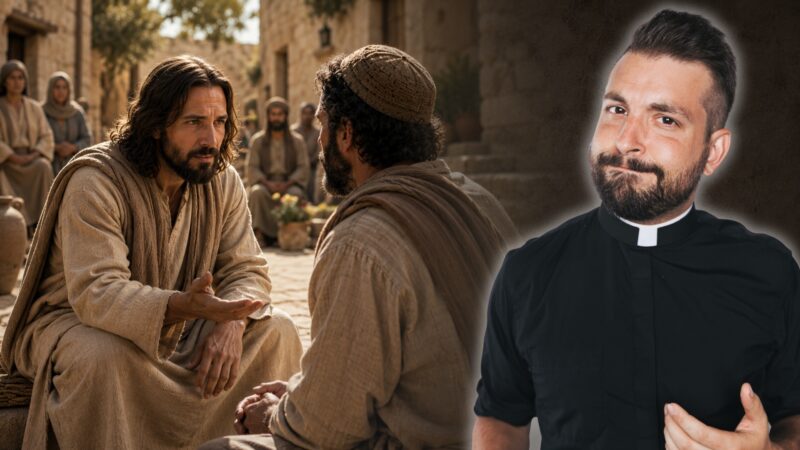
In this Sunday’s Gospel, Jesus brings Peter and the disciples to Caesarea Philippi, a place marked by a massive rock face and associated in the ancient world with pagan worship and the realm of the dead. Against that dramatic backdrop, Jesus tells Peter, “You are Peter, and upon this rock I will build my church, and the gates of the netherworld shall not prevail against it.”
Fr. Tim points to the setting as a vivid way of hearing Jesus’ words. But the Catholic understanding of Peter’s unique role rests above all on Christ’s own commission to him. Catholics understand Peter as receiving a particular pastoral and foundational role among the apostles, a ministry that continues in his successors.
Christ remains the ultimate foundation and head of the Church. Peter’s authority comes entirely from Him and exists in service to Christ and the apostolic faith. That gives Catholics reason for hope: the Church will face suffering, scandal, opposition, and human weakness, but Christ has promised that the powers of death and evil will not ultimately prevail against His Church.
Episode Transcript
[00:00:00 –> 00:00:02] I may be the stupidest priest that has ever lived.
[00:00:02 –> 00:00:06] I just learned that wifi is not the internet.
[00:00:06 –> 00:00:09] Wi-Fi is the signal that connects to the internet.
[00:00:09 –> 00:00:10] Never knew that. Wow.
[00:00:10 –> 00:00:14] The wifi is a radio signal that connects to the source.
[00:00:14 –> 00:00:18] And this is literally what theology of faith is.
[00:00:18 –> 00:00:22] Faith connects us to Jesus and is healing.
[00:00:22 –> 00:00:26] Faith is not the healing. It connects us to the source.
[00:00:26 –> 00:00:27] In the gospel for this Sunday,
[00:00:27 –> 00:00:32] the woman’s faith is not the thing that heals her daughter.
[00:00:32 –> 00:00:34] Jesus heals her daughter.
[00:00:34 –> 00:00:36] I think it’s helpful for us because I think a lot
[00:00:36 –> 00:00:38] of the times we think the more faith I have,
[00:00:38 –> 00:00:40] the more healing I’ll have.
[00:00:40 –> 00:00:42] The greater the faith, the more the miracles.
[00:00:42 –> 00:00:45] Jesus is the one who heals.
[00:00:45 –> 00:00:48] Jesus is the source of miracles.
[00:00:48 –> 00:00:51] So it takes all the pressure off of ourselves.
[00:00:51 –> 00:00:54] Faith is the wifi. It connects us to the source.
[00:00:54 –> 00:00:55] This is spirit use, peace.
Key Takeaways
- Jesus’ words to Peter, “upon this rock I will build my church,” are foundational to the Catholic understanding of Peter’s unique role among the apostles.
- Fr. Tim highlights the dramatic setting of Caesarea Philippi, a place associated in the ancient world with pagan worship and the realm of the dead. That setting can make Jesus’ promise about the gates of the netherworld especially vivid.
- The Catholic understanding of Peter’s role rests above all on Christ’s words and commission to him, not on the physical setting of Caesarea Philippi itself.
- Catholics understand the papacy as rooted in the particular ministry Christ entrusted to Peter. The title and historical form of the papacy developed over time, while Peter’s foundational pastoral role comes from Christ.
- Christ is the ultimate foundation and head of the Church. Peter’s authority is real but entirely received from Christ and exercised in service to Him and the apostolic faith.
- Christ does not promise that the Church will be free from suffering, scandal, persecution, or human failure. He promises that the powers of death and evil will not ultimately prevail against her.
What This Means for Prayer and Daily Life
It can be easy to become discouraged when we see problems within the Church, failures by Catholics, or disagreements among those who are supposed to follow Christ.
Jesus never promised that His Church would be free from struggle. His promise is deeper: the gates of the netherworld will not prevail against it.
Our confidence is not based on the perfection of the people who make up the Church. It rests in Jesus Christ, the Church’s ultimate foundation and head. He chose Peter for a particular mission of leadership and service, and He remains faithful even when members of His Church fail.
That does not mean every decision made by a Church leader will be perfect. Papal and episcopal authority is meant to serve the faith handed down from the apostles, not to replace Christ or invent a new Gospel.
When the struggles of the Church shake your confidence, return to Christ’s promise. Pray for the pope, the bishops, and all the faithful. Ask Jesus to keep you rooted in Him and faithful to the Church He established.
“Jesus, thank You for giving us Your Church. Strengthen my faith when I become discouraged. Guide the pope, the bishops, and all who serve Your people. Help me remain faithful to You and trust Your promise that You will never abandon Your Church.”
FAQ Section: Wi-Fi, Faith and Jesus
Jesus gives Peter a particular role among the apostles and connects that mission directly with the Church He is establishing. Catholics understand Matthew 16 as an important biblical foundation for Peter’s leadership and for the ministry that continues in his successors.
Caesarea Philippi provides a dramatic backdrop for Jesus’ words. The area was associated in the ancient world with pagan worship and the realm of the dead, which can make Jesus’ reference to the “gates of the netherworld” especially striking. The Catholic understanding of Peter’s authority, however, rests principally on Christ’s words and commission rather than on the location itself.
Jesus Christ is the ultimate foundation and head of the Church. Peter receives from Christ a real but subordinate foundational role within the Church. His authority comes from Christ and exists in service to Christ rather than independently of Him.
Catholics commonly call St. Peter the first pope because Jesus gave him a unique pastoral role among the apostles and the Church understands that Petrine ministry as continuing in his successors, the bishops of Rome. The title “pope” and many of the office’s historical structures developed later, but Catholics believe the essential foundation of that ministry is present in Christ’s commission to Peter.
Catholic teaching on the papacy is rooted especially in Christ’s commission to Peter, including His declaration that Peter is the rock, His gift of the keys of the kingdom, and the authority to bind and loose. The pope serves as Peter’s successor and as a visible principle of unity within the Church.
Jesus promises that death and the powers of evil will not ultimately overcome His Church. This does not mean the Church will never experience persecution, scandal, suffering, poor decisions, or human sin. It means that Christ remains faithful to His Church and evil will not finally defeat what He has established.ar, even in suffering.
Get New Episodes in Your Inbox
Sign up to receive a weekly reminder when a new Reel Homilies episode is released, along with a direct link to listen.
Support Reel Homilies
Reel Homilies with Father Tim Anastos is free to watch, but it’s not free to produce! Generous donors make it possible for us to continue creating this content. If you enjoy Reel Homilies, please consider making a monthly tax-deductible gift. Spirit Juice Entertainment Group (SJEG) is the non-profit arm of Spirit Juice Studios. It is a 501(c)3 organization that relies on your support to continue creating original, authentically Catholic content that reaches thousands of people each week through our website and social media channels.
Start a new monthly donation and receive an array of Reel Homilies and Spirit Juice swag in gratitude for your generosity. For more information, please visit our Reel Homilies Support page.
To qualify, you must donate a minimum of $25 per month. All gifts in between will be rounded down to the nearest package amount. Please allow 6-8 weeks for your package to be shipped. Questions? Contact us at [email protected]. Your donation is tax-deductible within the United States, and we will provide a tax receipt for your records.
You Might also like
-
Living on the Sidelines?
Sometimes, I feel like Guy. If you’ve ever seen the movie, “Free Guy,” you know that Guy is living his life on the sidelines. He doesn’t really think his life is about him. But at one point, Guy realizes that the video game that he is in is his story and that he is the main character. And he gets after it. On this Palm Sunday, we hear the entire story of Jesus’s passion for us. A lot of the time, we feel like we are on the sidelines…
-
The Best Institution
St. John Paul II once said that the greatest institution that has ever existed and ever will exist is the family. Greater than any corporation, league, or system we can imagine. On the Feast of the Holy Family, we’re reminded that Jesus, Mary, and Joseph placed their family life entirely in God’s hands and that trust led them into the greatest adventure of all. Their home wasn’t perfect or easy, but it was rooted in surrender. No matter how messy, broken, or complicated our own families may feel, we’re called to do the same. If we want to change the world, it has to begin with healing and holiness, in our families.
-
Something Greater Than Ourselves
Let’s talk about my dad. So when I was a kid, about a year ago… One of my most formative things was seeing my dad pray on his knees, praying to someone more important than him. As a kid, I saw my dad as the supreme commander of the universe. Seeing him answer to someone even more significant than him, loved by someone even greater than him, was so freeing for me just to be a kid and loved…